A math presentation is harder than most: you have to show formulas, graphs and the steps of a proof so that the audience can actually follow the logic. This page collects mathematics presentation topics for school and university, report and independent work topics, and practical tips for building clear math slides.
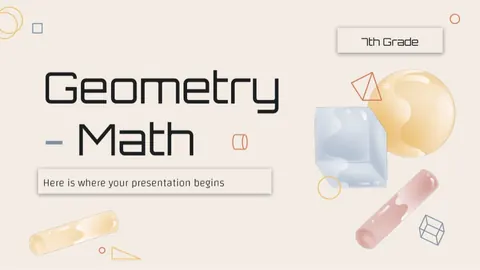
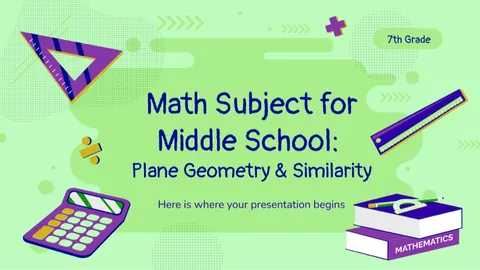
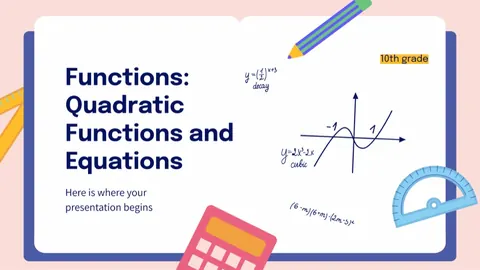
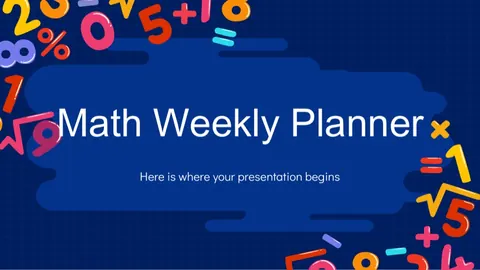
Above you can see the ready-made math presentation templates available in Aqlly. Pick a topic and a design, and the AI writes the slide content and builds a PDF presentation in a couple of minutes.
Mathematics presentation topics
Middle school (grades 5–7)
- Natural numbers and operations
- Fractions and decimals: differences and uses
- Percentages in everyday life: discounts, loans, savings
- Negative numbers and the number line
- Ratios and proportions
- Plane shapes: triangles, quadrilaterals, circles
- Perimeter and area
- Divisibility rules
- History of number systems and Roman numerals
- Symmetry in nature and architecture
High school (grades 8–11)
- Quadratic equations and Vieta's theorem
- Linear functions and their graphs
- The quadratic function and properties of the parabola
- The Pythagorean theorem and ways to prove it
- Trigonometric functions and the unit circle
- Arithmetic and geometric sequences
- Logarithms and their real-world uses
- The derivative and its geometric meaning
- Antiderivatives and integrals
- Polyhedra: prisms, pyramids and Platonic solids
- Solids of revolution: cylinder, cone, sphere
- Introduction to probability
- Inequalities and how to solve them
University level
- Matrices and determinants
- Systems of linear equations: Gaussian elimination and Cramer's rule
- Vector spaces and linear transformations
- Limits and continuity
- Differentials of multivariable functions
- Multiple integrals and applications
- Differential equations in modelling
- Taylor and Fourier series
- Mathematical statistics: mean, variance, correlation
- Graph theory and the shortest path problem
- Complex numbers and their geometric interpretation
- Linear programming and optimization
History of mathematics
- Al-Khwarizmi and the birth of algebra
- Where the word "algorithm" comes from
- Ulugh Beg's observatory and trigonometric tables
- Al-Biruni's contribution to mathematics and astronomy
- Jamshid al-Kashi and the calculation of pi
- Pythagoras, Euclid and Ancient Greek geometry
Modern topics
- Mathematics behind artificial intelligence
- Cryptography: prime numbers and internet security
- Fractals and the geometry of nature
- The golden ratio and Fibonacci numbers
- Big data and statistical analysis
- Financial literacy: the math of compound interest
Math report and independent work topics
These topics work well for a report (referat) or independent work — they have enough theory, examples and historical background:
- Al-Khwarizmi's "Book of Restoration and Balancing" and its legacy
- Ulugh Beg's Samarkand school and the development of trigonometry
- Foundations of number theory and the problem of primes
- Seven ways to solve a quadratic equation
- Applications of the derivative in physics and economics
- The definite integral and computing areas
- Probability theory and games of chance
- Mathematical induction
- Matrices in economic models
- Modelling population growth with differential equations
- Graph theory in transport logistics
- Statistical methods in social research
- Non-Euclidean geometries
- Complex numbers in electrical engineering
- Mathematical foundations of cryptography
- Linear programming and resource allocation
- Fourier series and signal processing
- Fractal geometry and its applications
- Teaching problem solving in school mathematics
- Mathematical logic and set theory
- Geometric transformations: translation, rotation, dilation
- Financial mathematics: loans and annuities
Tips for a strong math presentation
- One slide, one idea. Don't put more than one or two formulas on a slide. Make the key formula large and add a short explanation next to it.
- Clean notation. Show fractions, powers and roots in proper mathematical form and label what each variable means.
- Use graphs and diagrams. A function graph, a parabola, the unit circle or a geometric drawing explains faster than a paragraph.
- Worked example. Solve one problem in 3–4 steps so the audience can follow the reasoning.
- Real-life links. Explain percentages through loans, sequences through savings, statistics through a survey.
- Historical context. One slide on al-Khwarizmi or Ulugh Beg makes the talk memorable and shows Central Asia's role in science.
- Structure: title → outline → theory → proof or example → applications → conclusion → questions. To plan the length, see how many slides you need.
- Check every calculation. Any AI can make mistakes, and in math one wrong sign ruins the example — verify formulas yourself.
For general layout rules, read our slide design guide.
Sample outline: "The Pythagorean theorem" in 10 slides
This outline fits a 7–8 minute talk and is easy to adapt to other topics.
- Title — topic, author, class or group, teacher.
- Outline — 4–5 points you will cover.
- History — Pythagoras and knowledge of right triangles in Egypt and Babylon.
- Statement — a² + b² = c² with a labelled diagram of legs and hypotenuse.
- Proof (geometric) — a visual proof using the areas of squares.
- Proof (algebraic) — a short step-by-step derivation.
- Worked example — find the hypotenuse of a triangle with legs 3 and 4.
- Converse and Pythagorean triples — examples like 3-4-5 and 5-12-13.
- Applications — construction, navigation, screen diagonals.
- Conclusion and questions — the key idea in one sentence and a question for the audience.
How to create a math presentation in Aqlly
- Open @aqllyrobot in Telegram and press /start.
- Choose your language and the "Presentation" service.
- Enter the topic (e.g. "The quadratic function and its graph"), number of slides (5–15), output language and author name.
- Pick a template from the Mathematics category in the visual picker.
- Get the finished PDF in the chat in about 1–3 minutes.
New users get a 3,000 so'm welcome bonus — enough for one presentation of up to 10 slides. Learn more about the AI presentation maker or browse all templates. Need physics ideas instead? See the physics page.
Remember: AI output is a draft. Read it, check the math and add your own explanations.